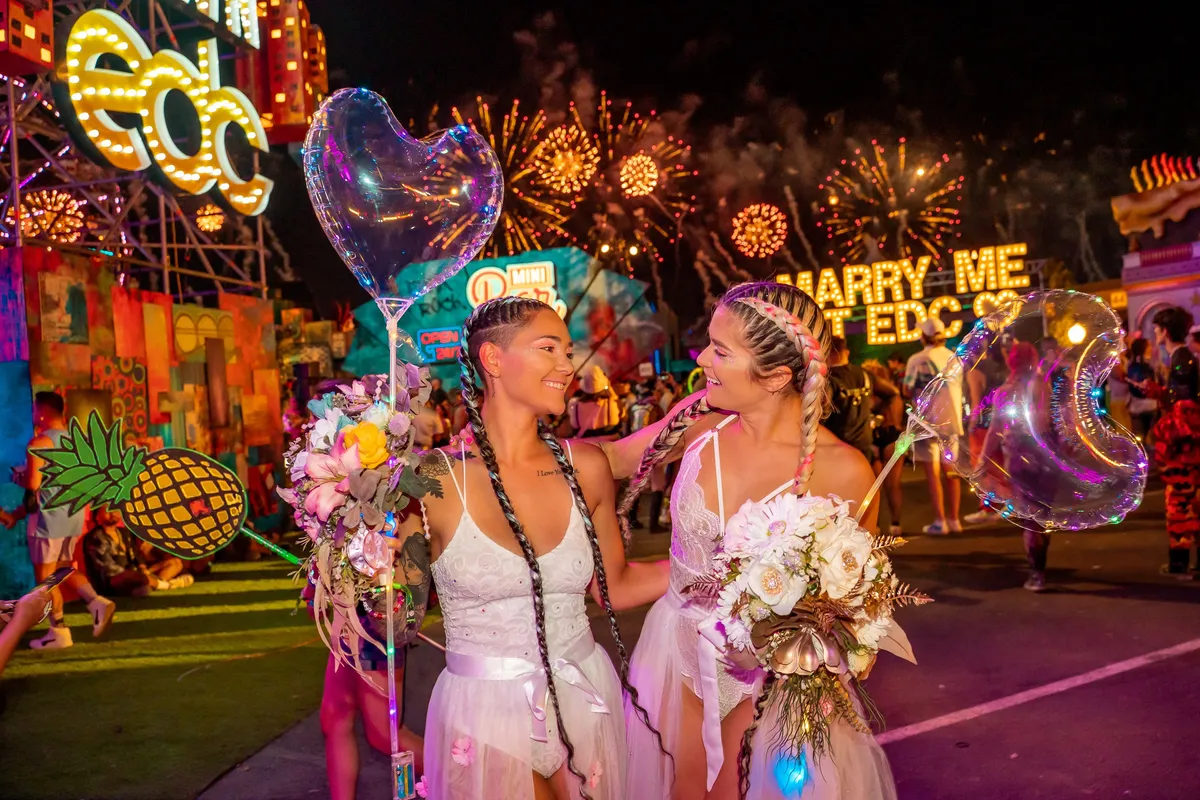
Walk into any rave today and PLUR is everywhere. It is on kandi bracelets. It is in the handshake people do when they trade them. It is in how someone turns around to apologize when they bump into you, or the way a stranger presses a cold water bottle into your hand when you look overheated. PLUR is a word but it is also a behavior, a code, a way of being in a room full of people you have never met.
Most people in the scene know what PLUR stands for. Fewer know where it actually came from. The full story is messier and more interesting than the version that usually gets told.
New York City, Late 1980s
To understand PLUR you have to understand what raving was before it had a name, a brand, or a $400 ticket price. The American rave scene grew out of two things happening at the same time: the explosion of house music coming out of Chicago and Detroit in the mid-80s, and a generation of young people in New York City who needed somewhere to go.
The parties were not legal. They were in warehouses, in tunnels, in empty lots in parts of the city that nobody was paying attention to. The flyers were photocopied and handed out in person. You found out about a party through someone who already knew, and that social trust mattered because the whole thing could get shut down at any moment.
In that environment, the culture that developed around the music was not accidental. When you are in an illegal space with strangers at 3am, the social contract has to be explicit. You look out for each other. You do not bring drama. You treat the space like it belongs to everyone, because for one night it does.
Walk into any show and you'll see it: four letters on a sign, a bracelet, a tattoo, a chant. P-L-U-R: Peace, Love, Unity, Respect, the closest thing rave culture has to a creed. But ask where it came from and you'll usually get a legend. The real story is messier, older, and honestly more beautiful, because no single person invented it. A whole community did.
The legend
The version most people know credits Frankie Bones, the Brooklyn DJ widely called the founding father of American raves through his early-'90s Storm Rave parties. As the story goes (told and retold on NE-RAVES, the University of Maryland mailing list where a lot of East Coast rave culture lived online), Bones finished a blistering set, stepped up, and explained what the scene was really about: peace, love, unity, and respect. The whole warehouse threw their hands in the air as one. It's a great story. It's also, according to someone who was in those rooms, not quite what happened.
The correction
In 1996, a DJ named Laura LaGassa posted her own account to that same list, and she'd been at nearly every Storm Rave. Her version pulls the credit apart and spreads it around. "Peace, love, unity" was already common slang in the New York scene by 1992. The missing piece was respect, and it came from elsewhere: a booklet called Cybertribe Rising by Geoff White, which laid out the "four pillars of the house community" and placed respect alongside the other three. The idea traveled east when San Francisco's Brian Behlendorf brought the literature to the coast.
Then came the moment that actually mattered. At a renegade party in the RFK Stadium parking lot in Washington DC in June 1993, Laura was talking about the spirit of raving and said "peace, love, unity," and Brian immediately added the line that completed it: and don't forget Respect. That stuck with her. She wrote an essay tying all four words together and posted it to NE-RAVES. It didn't have a name yet. Shortly after, another list member, Rishad Quazi, signed off an email with the acronym PLUR, and it spread fast and never left.
So what about Frankie Bones?
Laura doesn't erase him. He was a real catalyst and a genuine figurehead for the whole movement. But the speeches she actually witnessed tended to land on "peace, love and unity" without the fourth word. Her favorite Frankie moment wasn't even a sermon: a fight broke out at a party, and he leapt onto the turntables and threatened to break some faces if the crowd didn't show a little peace, love, and unity, right then. Pure Brooklyn.
Why the messy version is the right one
Put it together and PLUR has no single author. It's a booklet from one coast, a phrase from another, one person who added the fourth word, one who wrote it down, and one who turned it into four letters that fit in an email signature. Which is about the most PLUR origin story imaginable: a bunch of strangers, connected by a scene, each adding a piece. As they used to say on those old mailing lists: we are all connected.
The four words, then and now
Peace: with the room, and with yourself. Love: for friends, for strangers, for the version of you that showed up tonight. Unity: the thing that takes over when the bass drops and everybody, regardless of who they are, is in it together. Respect: for other people, for the music, and for your own body and limits. Thirty years on, ravers still argue about who said it first. Almost nobody argues about what it means.

The Kandi Handshake
At some point in the early 90s New York scene, someone started making bracelets out of plastic beads and trading them. The beads were cheap. The elastic was cheap. The making of them was meditative, something to do with your hands during the long weeks between parties. The trading of them became a ritual.
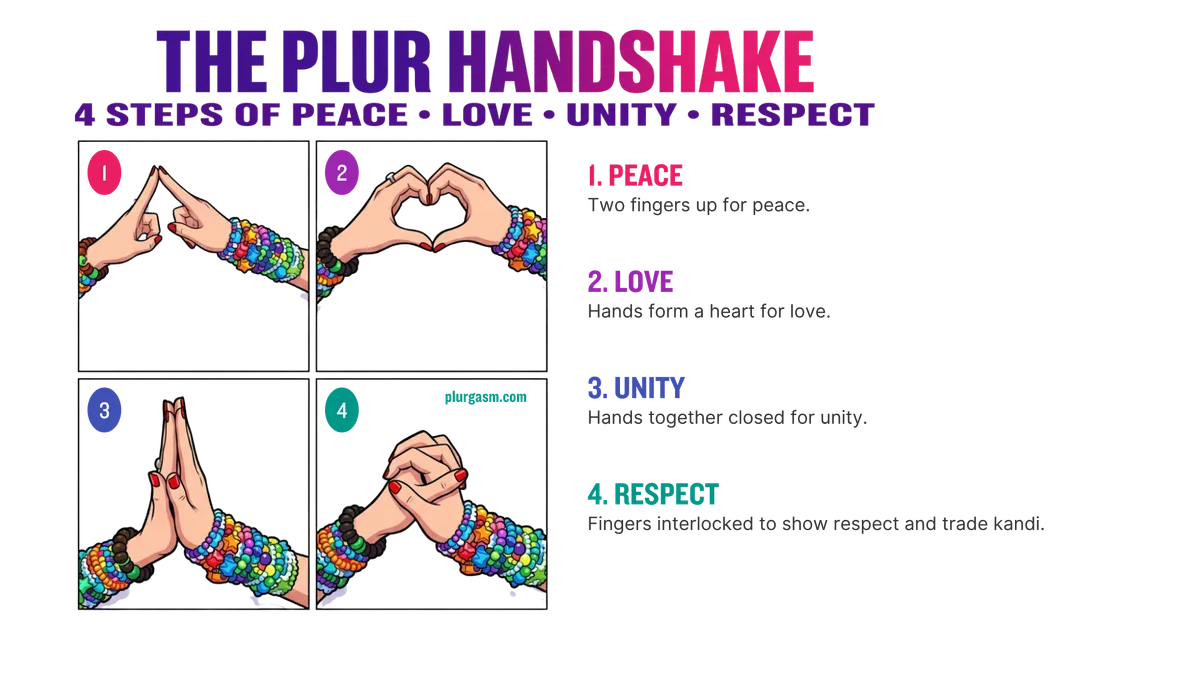
The PLUR handshake formalized that ritual. Four gestures, one for each letter. Press palms together for Peace. Lace fingers together for Love. Join thumbs for Unity. Slide the bracelet from your wrist to theirs for Respect.
What made the handshake significant was not the steps themselves but what the steps required. You had to slow down. You had to make eye contact. You had to be present with another person, in a genuine physical exchange, for long enough to feel it.
In a room where hundreds of people were moving to the same music, the handshake was the moment of actual connection. The bracelet you left with was proof of it.

How PLUR Spread
Through the early and mid 90s the rave scene expanded rapidly out of New York into other American cities. Chicago, Los Angeles, San Francisco, Miami. Each city developed its own character but the core cultural values traveled with the music.
The internet accelerated this. Early rave forums and mailing lists in the mid-90s carried PLUR discussions across cities and later across countries. People who had never been to a New York party understood what it meant because someone had taken the time to write it down and share it.
By the late 90s PLUR had become the de facto philosophy of rave culture worldwide. It showed up on flyers, on merchandise, in DJ dedications. It became so widespread that it also became, in some corners of the scene, shorthand for naivety. People who took it too seriously were mocked. PLUR was for kids who didn't know better.
That tension has never fully resolved. It is still there today every time someone rolls their eyes at a kandi trade and every time a stranger in a crowd quietly makes space without being asked.
The Commercial Era
When EDM exploded into mainstream American culture in the early 2010s, PLUR came with it. Suddenly it was on Urban Outfitters shirts. On jewelry in mall stores. On social media captions from people who had never been to a party that wasn't held in an amphitheater.
The scene veterans mostly hated this. PLUR had been theirs. A code from the underground. Watching it appear on a chain store rack felt like theft.
The critique was real but it missed something. Every generation of ravers had to discover PLUR for the first time. The kids buying the shirts were the same kids who would eventually show up to their first festival, trade their first kandi, and understand in their chest what the words actually meant. Commodification is ugly but it is also how subcultures reproduce themselves. The thing spreads further than it ever would have in the warehouse.
PLUR in 2026
The rave landscape today looks almost nothing like a Brooklyn warehouse in 1990. EDC Las Vegas draws 500,000 people. Festival tickets cost as much as rent. The artists headline arenas between their festival sets. The money involved would have been inconceivable to the people who coined the phrase.
And yet PLUR is still there. You can feel it in the moments that matter. When someone passes you a water bottle without you asking. When the crowd parts for a flow artist and closes again gently around them. When a stranger sits with someone who is having a hard time instead of stepping over them and walking on.
Those moments do not happen because of a shirt or a bracelet or a phrase. They happen because someone in the room chose to act that way, and someone else saw it and did the same, and it accumulated into a culture that is still recognizable thirty-five years after someone stopped the music in Brooklyn and said something that needed to be said.
That is what PLUR actually is. Not a slogan. A decision. Made over and over again, by different people, in different rooms, every night the music plays.
New to rave culture? Read our PLUR 101 beginner guide and visit the Safety and PLUR page for everything you need to know before your first festival.